

Independent analysis
Institutional Design and Individual Competence: why good people cannot save organisations built on the wrong structure
- What you will be able to do
- Tell whether your problem is a person or a structure, and what to redesign first.
- Reading time
- 8 minutes
- Then
- Take the free check, 5 minutes
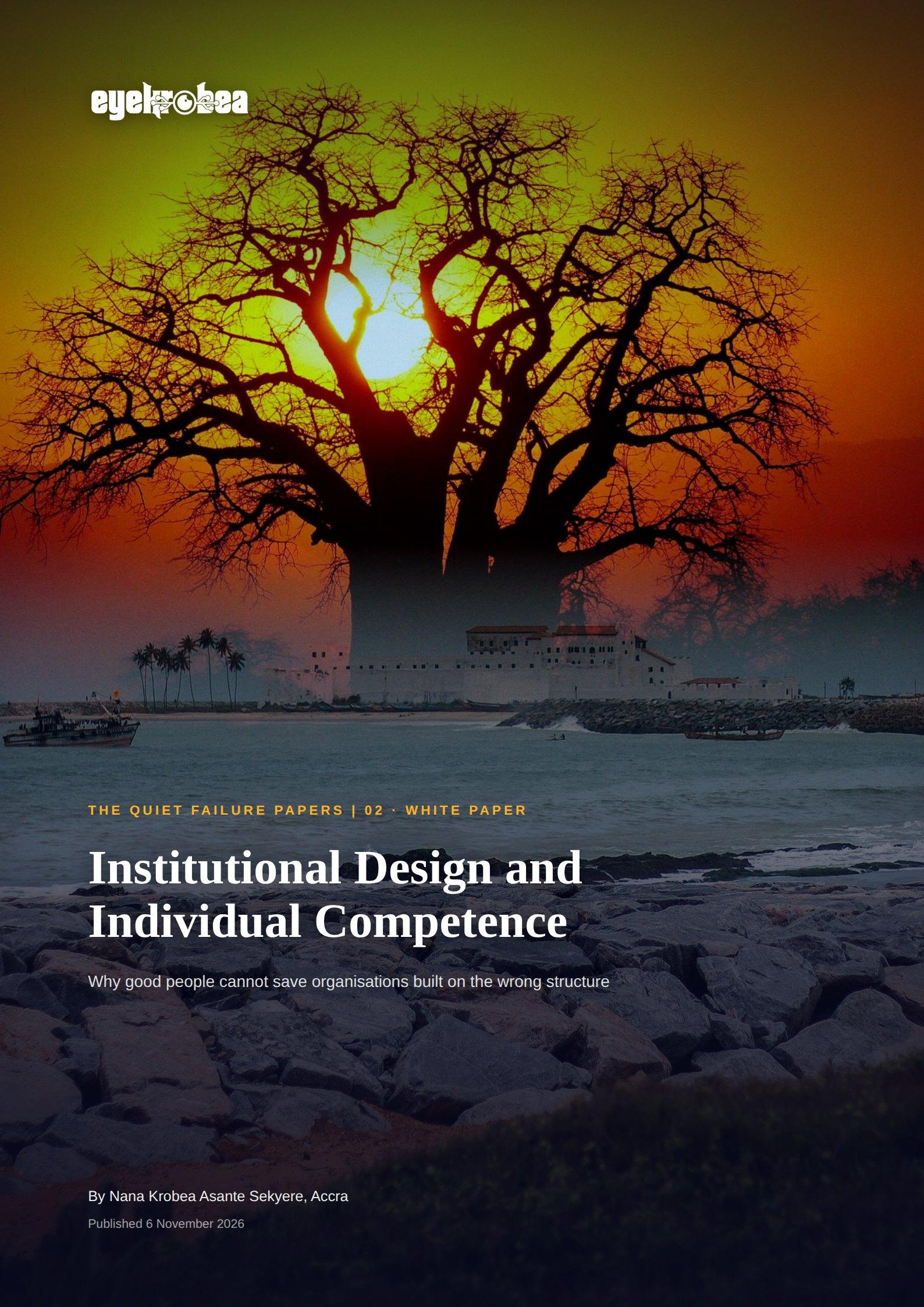
Why good people cannot save organisations built on the wrong structure
The Quiet Failure Papers | 02 White Paper Nana Krobea Asante Sekyere, Accra
1. The competence trap
There is a moment in many institutional reviews when the conversation turns to a person. A director is described as difficult. A manager is said to lack ownership. A team is characterised as resistant. These descriptions may be accurate, but they are rarely complete.
The competence trap is the assumption that performance is primarily a property of individuals. It leads to a familiar cycle: a problem is attributed to a person, the person is replaced, the problem returns in a slightly different form, and the institution concludes that it has a talent problem. Sometimes it does. More often, it has a design problem that keeps producing the same behaviour regardless of who is in the role.
This is not an argument against accountability. People must be responsible for their work. It is an argument for looking at the structure before concluding that the person is the cause. A competent person in a badly designed system will spend much of their energy compensating for the design. When they leave, the compensation leaves with them, and the underlying failure becomes visible.
2. Structure decides behavior
Structure is not only the organisation chart. It includes the way authority is distributed, the way performance is measured, the way information moves, and the way the institution continues when individuals are unavailable. These are not neutral background conditions. They shape behaviour every day.
Consider two institutions with the same goal and similar staff. In the first, a decision requires three approvals, none of which is documented, and the final approver is often travelling. In the second, the same decision has a named owner, a defined threshold, and a recorded outcome. The people may be equally capable. The first institution will be slower, less consistent, and more dependent on personal relationships. Its staff will appear less decisive, because the structure punishes decisiveness.
Structure also determines what is visible. If the information needed to make a good decision sits with someone who is not in the room, the decision will be made without it. The people in the room may be competent and well intentioned. They are still deciding blind. Over time, they learn to work around the gap, and the workaround becomes the real process.
The most important structural question is not who reports to whom. It is what the design makes easy, what it makes hard, and what it makes invisible.
3. Four structural faults
Four faults account for a large share of quiet institutional failure.
Unclear authority. When it is not clear who can decide, decisions either stall or get made twice. People escalate to avoid risk. Meetings multiply. The institution develops a culture of consultation that looks collaborative but is actually a way of avoiding accountability. The cost is not only speed. It is the loss of a clear record of who decided what, which becomes critical during audits and disputes.
Misaligned incentives. People respond to what is measured and rewarded. If relationship managers are rewarded for new business but not for renewals, renewals will receive less attention. If programme staff are rewarded for delivery but not for documentation, documentation will be treated as an interruption. The institution may state one priority while paying for another. The gap between the two is where quiet failure grows.
Information asymmetry. When the people who need information do not have it, and the people who have it do not need it, decisions degrade. This is not only a technology problem. It is a design problem. Information sits in personal inboxes, in the memory of a long-serving officer, or in a report that reaches leadership after the decision has already been made. The institution appears informed because information exists somewhere. It is not informed in the place where it matters.
No continuity. When critical knowledge and relationships live with a few individuals, the institution is dependent on their presence. This dependency is often invisible while those individuals are stable. It becomes visible during leave, resignation, illness, or growth. The institution discovers that it does not have a process. It has a person.
These faults rarely appear alone. Unclear authority produces information asymmetry. Misaligned incentives discourage documentation. Weak continuity makes every departure a crisis. Together, they create an institution that works through heroism rather than design.
4. What it looks like in practice
The pattern appears across sectors, with different symptoms.
A non-profit. Programme staff deliver well, but the organisation cannot produce a consistent report across donors. Each donor receives a slightly different version of the same programme because reporting is assembled by whoever is available. The staff are competent. The structure has no single owner for programme data, no standard reporting calendar, and no incentive to document work before a deadline. The failure is not in the field. It is in the design of the reporting function.
A financial institution. A credit approval process requires input from relationship management, risk, and operations. Each function has a different view of the client. No one owns the end-to-end timeline. Applications move quickly when a senior person intervenes and slowly when they do not. The institution interprets the variation as a workload problem. It is actually an authority and information problem. The process has no owner, only participants.
A college or clinic. A senior administrator holds the institution's regulatory knowledge, its relationships with key suppliers, and its understanding of several critical processes. The institution runs smoothly while she is present. When she takes extended leave, routine decisions stop. The response is usually to ask her to document more. That helps, but it does not address the deeper issue: the institution has built a single point of failure into its operating model and called it loyalty.
In each case, the individuals involved are not the problem. They are often the reason the institution has survived as long as it has. The problem is that the institution has not designed a way for its work to continue without extraordinary individual effort.
5. Redesign principles
Structural redesign does not require a large transformation programme. It requires a small number of disciplined decisions.
Name the owner of every critical handoff. Not every task. Every handoff, meaning the point where work passes from one person or function to another. A handoff without an owner is a gap. A gap is where quiet failure lives.
Make the decision rule explicit. For each recurring decision, define who decides, what information they need, what threshold applies, and how the decision is recorded. This reduces escalation, shortens cycle time, and creates the evidence trail that audits require.
Align measurement with the outcome you want. If renewals matter, measure them. If documentation matters, make it part of performance, not an afterthought. People are not being cynical when they follow the measures. They are being rational. The design should make the rational choice the right one.
Reduce single points of failure deliberately. Identify the processes, relationships, and knowledge that would be disrupted by one absence. For each, decide whether to document, distribute, or automate. Documentation alone is rarely enough if no one else has practiced the work.
Build a review rhythm. Structure drifts. New tools, new staff, and new client demands create gaps that did not exist before. A regular review of handoffs and decision rights keeps the design honest.
6. What leaders can do
Leaders cannot design every process. They can set the conditions in which good design happens.
First, ask structural questions before personal ones. When performance disappoints, ask what the person could see, what they were rewarded for, and what the structure made difficult. This does not remove accountability. It makes accountability fair and useful.
Second, protect the design work from urgency. Structural fixes rarely feel urgent until a failure occurs. The institution that repairs handoffs and decision rights during a quiet period is buying options for the next crisis.
Third, model the behaviour the structure requires. If leaders bypass defined processes, the processes will not hold. If they reward heroism over continuity, the institution will remain dependent on heroes.
Competence matters. It is simply not a substitute for design. The most reliable way to get consistent performance from good people is to build a structure that lets them do their best work without compensating for the structure around them.
A note on method
The examples in this paper are illustrations. They are invented composites that show structural patterns, not case studies of real clients. They are not evidence of how often these patterns occur.
Suggested citation
Nana Krobea Asante Sekyere. Institutional Design and Individual Competence: Why good people cannot save organisations built on the wrong structure. The Quiet Failure Papers, 02. Accra: Nana Krobea Asante Sekyere, 2026.
The Quiet Failure Papers is an independent research series by Nana Krobea Asante Sekyere, based in Accra, Ghana. It publishes practical papers on how institutions fail quietly, and what leaders can do about it.
Also in this series: The Quiet Failure Report 2026 · The Silent Revenue Leak. More papers are planned.
Cover photographs, graded for this paper: Brans Wyte GH, CC0; Gopal Vijayaraghavan, CC BY 2.0, via Wikimedia Commons.
What to do next
Tell whether your problem is a person or a structure, and what to redesign first.
Step 1, free, no email
Take the free checkAbout 5 minutes. You see where you stand and what to look at first.
Step 2, if the check shows gaps
The 14-Day Readiness ScanA short written first look at where to start, and a straight answer on whether you need more.
Step 3, if you would rather talk it through
Start a conversation