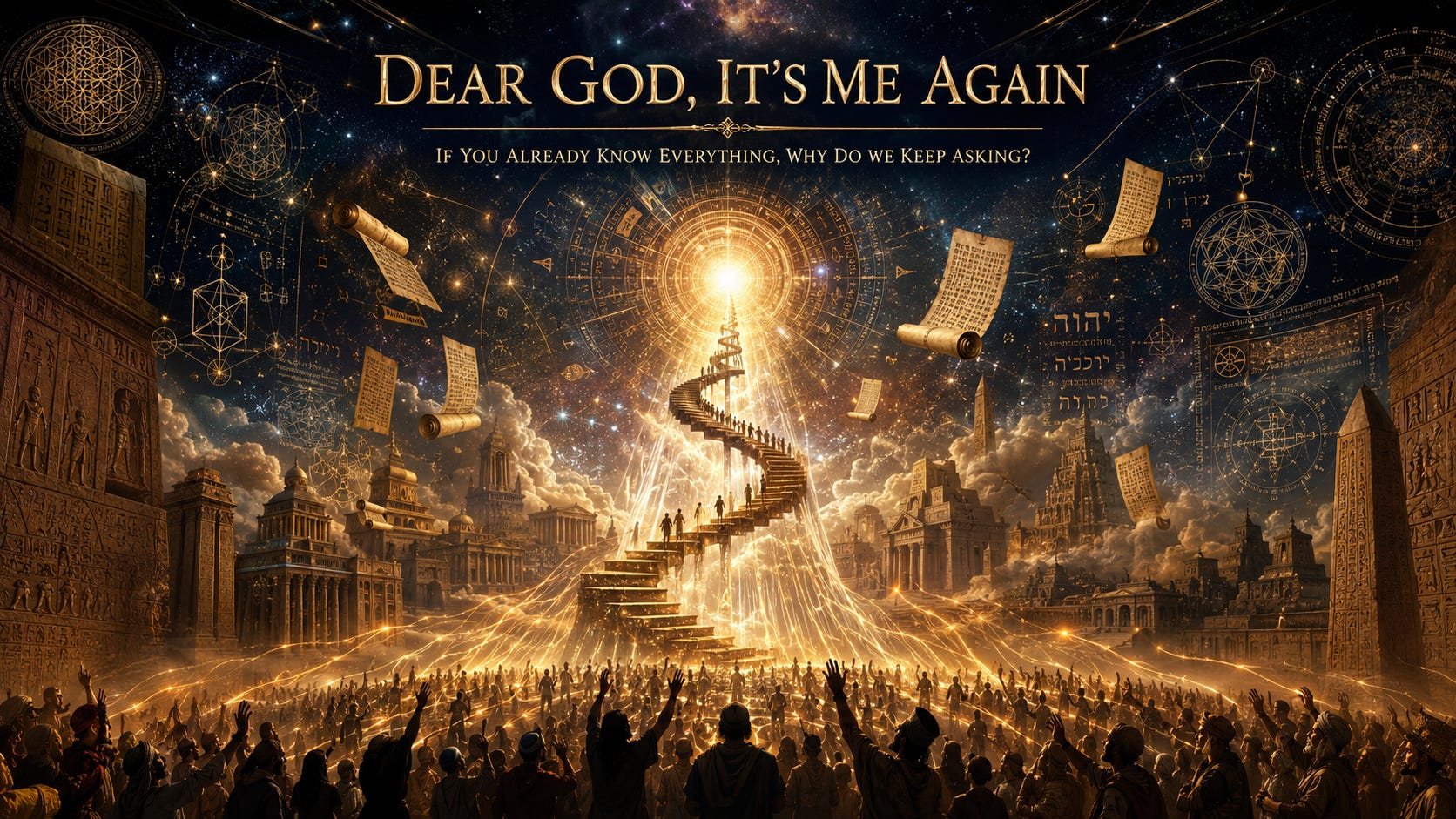
Every day, billions of prayers rise into the sky.
A mother prays for her child.
Two armies pray for success in battle.
A businessman prays for a promotion while another prays for the same position.
A student prays before an exam.
A patient prays before surgery.
A soldier prays before battle.
A prisoner prays for freedom.
Two political candidates pray for victory.
A farmer prays for rain while a wedding planner prays for sunshine.
An athlete prays for success.
Somewhere on the opposite side of the world, another athlete is praying for the exact opposite outcome.
The drama is almost cosmic.
Imagine listening to it all.
Millions asking.
Millions pleading.
Millions bargaining.
Millions reminding God about problems He supposedly already knows about.
This raises a question that few people seem willing to ask.
If God is truly God, why does He need so many reminders?
This question is coming from the very definitions or even attributes believers themselves use.
God is all-knowing.
God is all-seeing.
God is all-powerful.
God knows the end from the beginning.
God knows our thoughts before we speak.
God knows our needs before we ask.
If those claims are true, prayer cannot primarily be about informing God.
What information could an all-knowing Being possibly be missing?
Jesus himself appears to acknowledge this tension.
In Matthew 6:8, he tells his followers:
"Your Father knows what you need before you ask him."
The statement creates a logical dilemma.
If God already knows, why ask?
The question becomes even more interesting when we look beyond Christianity.
In Psalm 139, the Hebrew scriptures declare:
"O Lord, you have searched me and known me. You know when I sit down and when I rise up; you discern my thoughts from afar."
The Quran echoes a similar idea.
Surah Qaf 50:16 states:
"And We have already created man and know what his soul whispers to him, and We are closer to him than his jugular vein."
The Bhagavad Gita presents a similar picture of divine awareness:
"I am seated in the hearts of all beings."
Different traditions.
Different languages.
Different cultures.
Yet the same fundamental claim.
The Divine already knows.
So why do humans keep explaining things to God?
Perhaps because prayer was never designed to transfer information.
Perhaps it was designed to reveal the condition of the person praying.
Think about how most people pray.
Many conversations with God begin only when life begins falling apart.
The prayer life of humanity often resembles a customer service department during a crisis.
The car breaks down.
The prayer starts.
The money disappears.
The prayer starts.
The diagnosis arrives.
The prayer starts.
The relationship collapses.
The prayer starts.
Then the crisis ends.
The conversation often disappears.
Imagine treating a friend this way.
Imagine only calling someone when you need money.
Imagine only speaking to your parents when you need help.
Imagine only contacting your spouse when something goes wrong.
Would we call that a relationship?
Or would we call that dependency?
This is where the discussion becomes uncomfortable.
Many believers refer to God as Father.
Yet many prayers sound less like trust and more like panic.
Consider a child with a loving father.
The father provides;
Food. Shelter. Protection. Guidance.
The child knows the father is present.
Now imagine that same child calling every five minutes.
"Dad, don't forget to feed me."
"Dad, don't forget to protect me."
"Dad, don't forget to take care of me."
"Dad, don't forget I exist."
Eventually we might wonder whether the problem is forgetfulness on the father's side or trust on the child's side.
Of course, this argument has an important counterpoint.
Scripture does encourage asking.
Jesus says:
"Ask and it will be given to you; seek and you will find; knock and the door will be opened to you."
The Quran says:
"Call upon Me; I will respond to you."
The Hebrew scriptures are filled with prayers for protection, provision, healing, and deliverance.
To ignore these verses would be intellectually dishonest.
The traditions clearly permit asking.
The real question is whether asking is the highest form of prayer.
When we examine the deeper layers of spiritual literature, a fascinating pattern emerges.
The further one travels into the mystical heart of religion, the less prayer becomes about acquisition.
It becomes about alignment.
The Jewish mystics sought union with the Divine Will.
Christian contemplatives practiced surrender.
Islam means submission.
The Bhagavad Gita teaches action without attachment to outcomes.
Buddhist traditions encourage releasing craving altogether.
The ancient Taoist sages spoke of flowing with the Way rather than forcing reality.
The pattern repeats across civilizations.
The deeper the spirituality, the less the obsession with getting.
The greater the focus on becoming.
Even Jesus demonstrates this shift in Gethsemane.
Facing death, he prays:
"Not my will, but yours be done."
Notice what happens.
The prayer moves from request to surrender. From desire to alignment. From control to trust.
Perhaps this is why gratitude appears everywhere.
Psalm 100 says:
"Enter his gates with thanksgiving and his courts with praise."
The Quran teaches:
"If you are grateful, I will surely increase you."
The Bhagavad Gita repeatedly emphasizes devotion and remembrance over material requests.
Even modern psychology has discovered what ancient wisdom traditions already knew.
Gratitude changes;
perception.
emotional well-being.
behavior.
relationships.
In many cases, gratitude changes the person even when circumstances remain unchanged.
This leads to a possibility many people have never considered.
What if prayer was never meant to change God's mind?
What if prayer was meant to transform human consciousness?
What if the purpose of prayer is not to persuade Heaven but to prepare ourselves?
To become less fearful.
Less attached.
Less anxious.
Less self-centered.
More aware.
More trusting.
More grateful.
More aligned.
The greatest mystery may not be whether God hears us.
The scriptures seem overwhelmingly convinced that He does.
The greater mystery is whether we hear Him.
Perhaps;
prayer begins with asking.
it matures into gratitude.
Perhaps it deepens into listening.
And its highest form is neither asking nor receiving.
its highest form is remembering that the Source was never absent in the first place.
And maybe that is the irony of the entire human story.
We spend our lives searching for a God we claim is everywhere.
We beg for guidance from a Wisdom we believe created the universe.
We ask for provision from the Source that sustains every breath we take.
We pray for signs while standing in a reality that many traditions insist is already filled with them.
Perhaps the greatest spiritual question is not whether God exists.
Humanity has debated that for thousands of years.
Perhaps the greater question is whether we have misunderstood the nature of our relationship with the Divine.
What if prayer was never meant to be a daily negotiation?
What if it was meant to be a daily remembrance?
Not a reminder for God.
A reminder for us.
A reminder that life itself is a gift.
A reminder that consciousness is a mystery.
A reminder that existence is happening before we ever ask for the next thing.
A reminder that gratitude may be closer to wisdom than endless wanting.
This does not mean we should never ask.
Every child asks.
Every human being hopes.
Every heart longs for something.
The question is whether our asking comes from trust or from fear.
As, there is a profound difference between saying:
"God, give me what I need."
And saying:
"God, help me see what has already been given."
One seeks possession.
The other seeks perception.
One assumes absence.
The other assumes presence.
And potentially that is where prayer reaches its highest expression.
Not when we speak the most.
Not when we ask the most.
Not when we cry the loudest.
However, when for a brief moment, the noise inside us becomes quiet enough to recognize that the Presence we have been calling out to may have been beside us all along.
Waiting not to be informed.
Waiting to be noticed.